
How to get free edu email
A free .edu email address is one of the most searched-for things on the internet, and almost everything written about it is wrong. A .edu address is not a product you can download, generate or buy — it is issued by an accredited institution to a person it has enrolled. This guide explains how these addresses actually work, which routes to one are real, and what a temporary inbox can genuinely do for you instead.
What a .edu address actually is
In the United States, .edu domains are managed under rules that limit registration to postsecondary institutions accredited by an agency recognised by the Department of Education. An institution receives one domain, and transferring it to another party is not permitted. The practical consequence is simple: no website outside an accredited institution can issue you a genuine .edu mailbox, and any service claiming to generate one is not describing what it really provides.
Why student programmes are not fooled by the address alone
This is the part most guides leave out. Services such as the GitHub Student Developer Pack, Adobe, Spotify and Amazon Prime Student do not grant access simply because an address ends in .edu. They verify enrolment against official institution records, and when automatic matching fails they ask for documentary proof — a dated student ID, a class schedule, or an enrolment letter. An address that is not tied to a real enrolment record will not pass those checks, whatever its domain looks like. Attempting it is also a breach of those programmes' terms, and accounts obtained that way get revoked.
Legitimate ways to get a .edu email address
Enroll in a community college course
This is the route that actually works. Many community colleges in the United States operate open enrolment and issue a .edu address on registration, including for a single low-cost course or a certificate programme. You become a real student, so the address is tied to a real enrolment record and verification systems recognise it.
Check with your alumni association
If you have already graduated, your university may offer alumni a lifetime forwarding address or a permanent mailbox. Policies differ by institution, so it is worth asking your alma mater's alumni office directly.
Accredited online programmes and national portals
Accredited distance-learning programmes issue institutional addresses in the same way campus programmes do. Several national education systems also provide student accounts through their own official portals, which serve the same purpose within those countries.
What a temporary email address is genuinely good for
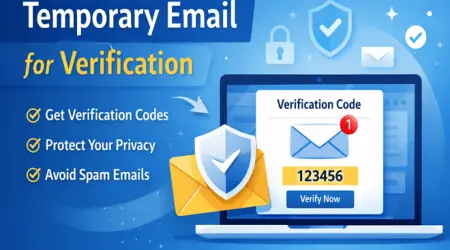
A disposable inbox solves a different problem, and a very real one. When you sign up for a forum, download a whitepaper, claim a trial or register for a one-off service, you hand over an address that will be stored, analysed and often sold. A temporary inbox absorbs that traffic: you receive the confirmation link or the one-time code, finish what you came to do, and your personal mailbox stays clean. Nothing arrives there six months later.
It is also a privacy measure. Your main address is an identifier that links your accounts together across services. Keeping it out of low-trust sign-up forms reduces how much of your activity can be correlated by data brokers, and limits your exposure when one of those services is breached. That is what this site is built for — a free temporary address, created in seconds, with no signup and no login.
The honest summary
A temporary address is a privacy tool, not a credential. Use it to keep spam and tracking away from your real inbox and to receive verification codes safely. If you need a .edu address, enrol in a course or contact your alumni office — that is the only route that actually works, and it is cheaper and faster than people assume.
Tags:
Need a disposable inbox right now?
Generate a free temporary email address on the
Edumaili homepage — no signup, no password, no personal details. Use it
to receive verification codes and OTPs, then let it expire and keep your real
inbox private. It is a privacy tool, not a student credential: it cannot be
used to obtain a .edu address or student pricing.